


Senior living developers, owners, and operators have goals and visions for communities, and two main goals of every senior living community are to gain residents and maintain stabilized capacity. There are shifts in the changing cultural backgrounds and preferences of target markets and decision makers, as well as their wealth distributions. Let’s look into the factors of resident retention that affect senior living communities.
Factors Affecting Resident Turnover
Many factors affect resident retention in seniors housing. The reasons for resident turnover can be grouped into main categories for changing their residence. These include environment, health and care level, cost, and social aspects.
Staff and Resident Turnover and the Environment Created
Everyone knows the importance of the community workforce. From care for each resident to the delicious meals they enjoy, and community housekeeping and maintenance needs to activity or life enrichment directors, the workforce of a community is the community. So, it shouldn’t come as a surprise that high employee turnover is heavily correlated with resident turnover.
Creating meaningful relationships with the people you interact with on a daily basis is what we do as humans, and having those relationships severed on a consistent basis would cause anyone unease.
We can’t decrease resident turnover when we have high employee turnover, so what are the key driving factors of employee turnover? The main reasons why employees leave include:
- Forced or mandatory overtime
- Staffing shortages
- Excessive workloads
- High resident-to-staff ratios
There is a common connection among all of these reasons that directly impacts residents. With these issues present, each resident isn’t getting the amount of individualized personal care they need.
Health Issues/Needed Care
For many, the decision to move into senior living can be for medical or health needs. This is no different from increasing the level of care that different communities provide. Moving along the continuum from active adult to independent living, assisted living, or memory care is a common reason to change communities, resulting in resident turnover. When residents opt to change communities, or they are required to move due to health events, it is typically because their community does not provide the next needed level of healthcare, or they are moving to be closer to family.
Decisions based on declining health or an increased need for care typically occur rather quickly. It’s like any other health-related event; the outcomes and next steps are put into place rather rapidly. This is the same reason why move-ins can occur the same week, or even day, with new prospecting residents or family members.
The Cost of Care
To get in the mind of senior living community residents and their families and loved ones who help make decisions, one may think that the cost of community care is an important indicator. Although it may be a larger factor in the initial search, it is not a key reason why a resident would move from one to another. When residents find a community and build relationships, the return for changing all of that for cost is not a typical driver.

According to Senior Care’s research with CDC data, cost is not the main driver for resident turnover. In fact, only 10% of residents who move did so because of the cost of care within the community.
Social Aspects
We are social by nature, and that doesn’t go away with age. CarePredict gives three top ways to retain residents and help maintain higher resident satisfaction.
- Create meaningful bonds with staff and other residents
- Stay active and healthy
- Have homelike surroundings
Having an environment that is inviting and cultivates connections positively impacts everyone involved, residents and team members alike.
Where Residents Go If They Leave
Now that we know the main reasons residents leave, let us look into the different options they choose when they leave. SeniorCare compiled data from NIC and ASHA to group where residents choose to go when they leave a community.
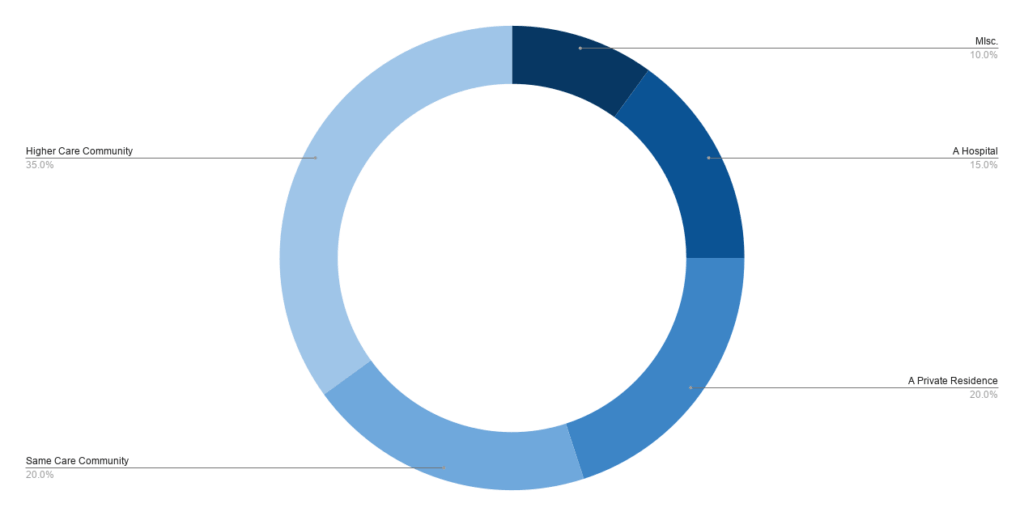
Of the residents who move out of a community, 35% go to a community with a higher level of care, for example, moving from active adult to assisted living. 15% of residents are admitted into a hospital for continued care. 20% move into a private residence after they leave. As some of these could be decreased slightly by higher safety protocols, there is one in particular that should be focused on.
The 20% that move into communities that offer the same level of care are the target turnover residents. These are the groups of residents in which we can have the most impact in decreasing resident turnover in our communities. Targeting this group, while taking into account the most prevalent reasons residents leave, could eliminate 20% of resident turnover.
Average Turnover Rates by Senior Living Type
Not all community types experience resident turnover in equal amounts. NIC conducts surveys to give insights into the senior housing market. Their research found that senior living communities experience annual turnover rates at vastly different rates. Communities with only independent living have a median annual resident turnover of 39%, while communities that are exclusively assisted living have a median of 59.5% resident turnover annually. Communities with both independent and assisted living experience a median annual resident turnover rate of 43.4%, but communities that have independent living, assisted living, and memory care have a rate of 46.5%.
With the communities offering a continuum of care, having higher resident turnover than independent living communities annually, it is apparent that generalizing and trying to appeal to every stage of senior living may not be the best option. As we’ve discussed in other blogs, the population has become and with such have been shifting preferences. This means that specialization may be the key to decreasing the controllable variable in resident turnover.
What Does This Mean For Managers, Operators, and Owners?
Since we’ve identified the key factors of resident turnover, we can create a plan to actively mitigate and combat each aspect. The next step is evaluating which aspects of your community are affecting your resident turnover and putting steps in place to improve. Once these are addressed, scaling and targeting your audience to produce new leads and move-ins.
Whether that is planning a remodel, combating resident turnover and labor shortages, creating a new activity program, or targeting your audience to generate more leads, we are here to help. Contact Solinity today.
This is part of the economic mini-series written by Amanda Barnett.