


As the population ages, each new generation becomes the prominent decision makers of the time, driving change for everyone. In turn, evaluating the younger generations can give us insight into the changes that are likely to occur in the future. Differences such as economic distribution can cause drastic changes, influencing the future of the senior living industry as the resident population’s financial needs and socioeconomic preferences continue to change.
Generations and How They are Divided
Generations are about 15-20 years and are used as a way to categorize people into similar age groups. These groups were created based on a normal timeframe for an individual to be born and grow up. Since this is a range, the defining “edges” of each generation is slightly flexible.
There are 7 generations currently living in the US.
- Greatest Generation – born about 1901 to 1925
- Silent Generation – born about 1925 to 1945
- Baby Boomers – born about 1945 to 1965
- Generation X – born about 1965 to 1980
- Millennials – born about 1980 to 1995
- Gen Z – born about 1995 to 2013
- Generation Alpha – born about 2013 to 2025
The overall trend and views of each generation become the leading and most influential voice of the population as that cohort becomes the driving force of that time. This is partially due to the largest population amounts as well as the largest portion of the workforce at the current timeframe.
Population Distributions Among the United States Population
As a population ages, there is a flow in and out of the workforce. The workforce includes anyone 16 or older who is working or looking for work. Pew Research Center has used Census Bureau data to calculate workforce percentages. In 1994, the Baby Boomers made up 50% of the workforce, and Gen X made up 29%. Later, in 2017, Baby Boomers decreased to 25%, and Gen X increased slightly to 33% of the workforce. Millennials have joined the workforce since 1994 and made up 35% in 2017. In 2016, millennials became the majority of the United States workforce at 56 million.
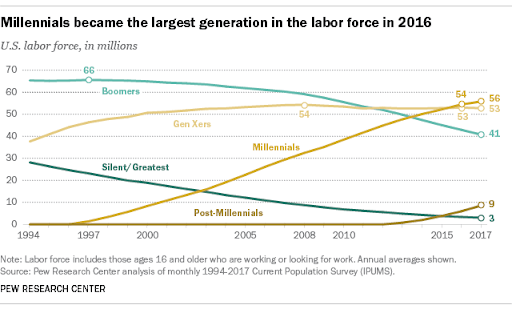
With more than 1 of every 3 workers being of the Millennial generation, how is the labor force peak skipping Generation Xers? Duffin shares 2021 population insights behind this. The boom of births after World War II, coining the Baby Boomer name, remains the second largest generation group by population. They are second only to the Millennials, who are a growing population. This may seem impossible, but this stems from the influx of young immigrants into the US population and workforce.
Wealth and Household Income
The median household income has had an average upward trend, increasing from $50,200 in 1970 to $74,600 in 2018. Pew Research Center used Census data to calculate household income distributions.

While household income is on the rise, the gaps between income levels are widening. The upper household income increased by $81,300, from $126,100 in 1970 to $207,400 in 2018. The lower household income, on the other hand, only increased by $8,200, from $20,000 in 1970 to $28,200 48 years later in 2018.
To put this into perspective, this would be the same as getting raises totaling $3.94 per hour more than when you started working 48 years prior. Let’s take it one step further. According to the U.S. Bureau of Labor Statistics inflation calculator, $1 back in 1970 is equivalent to $6.56 in 2018.
Wealth Differences Among Generations
According to Insider’s findings with the Federal Reserve data, the Baby Boomer generation has outpaced the other generations in wealth. The Silent Generation has increased its wealth, but not as drastically as the Boomers, as they reach retirement.

Gen Xers’ and Millennials’ wealth has decreased, which indicates a significant lag behind the Baby Boomer generation at the same age levels. A $600,000 gap between the average net worth of Millennials and Boomers at the same age was found. One possible cause is that Millennials earn 20% less on average than the Baby Boomer generation did at the same age.
Today’s Gen Xers own LESS THAN HALF of the wealth of Baby Boomers at the same age.
Self uses data from the U.S. Federal Reserve and found that in 2021, 67.4% of the country’s wealth was owned by the Baby Boomer and Silent Generations. Gen Xers only held 27.6% in 2021. This leaves Millennials owning 5% of the country’s wealth, all while they have been the largest portion of the workforce. However, this 5%, which Millennials account for, can be further divided because Mark Zuckerberg alone can account for 2%. This leaves only 3% collectively for all other Millennials combined.
What Does This Mean for Senior Living?
So the distribution of wealth is changing. Younger generations hold less accumulated wealth at the same age as previous generations. Why does this matter?
Changes in wealth distribution, the cost of living, and other socioeconomic factors create fluctuations in demand. The demand for senior housing is no different. The need for housing may not change, but the ability to afford housing would be drastically different. This could range for individuals from being a part of the workforce longer, being in multigenerational households, or even choosing an option that doesn’t serve their physical or medical needs.
With the shift in demand, the supply is affected and must adapt as well. On the developer or operator side of senior living, that means pricing may need to decrease to accommodate the fluctuation in attained wealth or specialization for niche markets.
Whether you’re on the supply or demand side of the equation, changes in wealth distribution and the worth of a dollar affect all aspects of the senior living industry. Contact Solinity for your development, management, marketing, and consulting needs.
This is part of the economic mini-series written by Amanda Barnett.